
Welcome to The Poverty Trap, a newsletter and podcast for people who are fed up with the inequality baked into America’s system and want to individually and collectively make change.
Thinking about subscribing? Here’s what one “founding member” subscriber recently had to say about The Poverty Trap:
“You do great work, Joan. I don’t always get to read your newsletter, but when I do, I leave more informed and more compassionate…” Amy B.

Here’s The Poverty Trap’s reading round-up for the “Merry, Merry Month of May”, as promised. I’ve been a bit behind on posting in May due to unforeseen circumstances, but I’ll return to a weekly posting schedule starting this coming week. Hope to see you then!
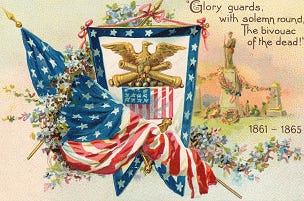
— In the meantime, I’ll start with a nod to this past Memorial Day, or Decoration Day as it used to be called, when Americans “decorated” with flowers, the graves of those who gave their lives in war, ostensibly to preserve freedom and democracy for the rest of us. You can read more about the history of Memorial Day in this publication from the National Cemetery Association, a part of the U.S. Department of Veterans Affairs.
More important than facts about how this annual tribute to our fallen soldiers came about, I’m sharing a moving essay written by Steven Beschloss for his Substack newsletter America, America that discusses, among other issues, the meaning of “sacrifice”.
We cannot fully comprehend or measure the scale of sacrifice so many Americans and their families have made, including in more recent wars in Iraq, Afghanistan and Vietnam. Each loss is a tragedy. But we can cherish and honor their collective memory by doing what we can now to sustain their courageous commitment to securing a world of democracy, tolerance and freedom.
— And speaking of paying tribute to the fallen, I can’t help but add a bit if levity to the (appropriately) solemn tributes this Memorial Day, with one of my favorite satirical “press releases” from Andy Borowitz, writer of The Borowitz Report:

— Returning to more solemn affairs, The New York Times published two articles in May showing the impact that President Trump’s economic policies and foreign policy decisions are having on a broader economic range of Americans, in addition to the poor and middle class.
The first piece highlights “the hamster wheel of credit” many American families must lean on to make ends meet amid the current, soaring cost of necessary goods and services. In one example, a family of four can no longer afford their typical lifestyle without supplementing their $140,000/year income with credit card debt:
For the Watts family [the family of four mentioned above], higher gasoline costs are one factor pushing up their spending. The cost of a gallon of gas near their home rose 70 cents overnight one day late last month. Their home energy bills have also soared: Mr. Watts’s gas bill, which is normally under $100, was almost $400 in February.
That’s compounding the stress that inflation has inflicted on his family’s budget. His grocery bill is more than $1,000 a month higher than it was a few years ago.
Another recent NY Times story explains how rising costs and deflated consumer expectations have effectively stopped first-time homebuyers from jumping into the housing market. Here’s how it works:
Prolonged conflict in the Middle East could keep energy prices high and slow global economic growth, hitting sectors like the U.S. housing market, Moody’s Analytics said in a recent report. Rising inflation expectations would suppress demand for homes, especially for first-time buyers, Moody’s added…Fears of broadly higher inflation have led bond traders to bid up the yields on 10-year Treasury notes, a major influence on mortgage rates. The average rate for a 30-year fixed-rate mortgage, which dipped below 6 percent just before the war started, has since jumped to 6.37 percent, according to the mortgage financing giant Freddie Mac.
Note: The current 30 year fixed mortgage rate is between 6.53—6.56 percent
I don’t think I need to tie together our government’s policy choices with every Americans’ ability to make the best choices for themselves and their families, and their ability to live the “American Dream”. The connections are self evident—our government starts a war, prices soar, consumer confidence plunges and millions of Americans can’t buy groceries, let alone their first home.
On the other hand, Mr. Springsteen and the E-Street Band’s latest American tour can helps us make sense of the connection between who we choose to elect and how our lives turn out. I just celebrated my 50th year of seeing Springsteen in concert, and his Land of Hope and Dreams tour could be his most powerful and moving yet. Here’ what “The Boss” has to say about the current administration and the choices we must make together to fight for our freedoms, taken from the opening remarks of his show in Boston:
Good evening, Boston. Welcome to the “Land of Hope and Dreams” tour. We begin the night with a prayer for our men and women in service overseas. We pray for an end to this conflict and for their safe return.
The E Street Band is here tonight in celebration and defense of the American ideals and values that have sustained our country for 250 years. We are here to call upon the righteous power of art, of music, of rock and roll in these troubled times. Our democracy, our constitution, our rule of law are being challenged right now as never before by a reckless, racist, incompetent, treasonous president and his ship of fools administration.
So, tonight, we ask all of you to join with us in choosing hope over fear, democracy over authoritarianism, the rule of law over lawlessness, ethics over unbridled corruption, resistance over complacency, truth over lies, unity over division, and peace over war.
I’d love to hear your ideas on my reading round-up for this month. Memorial Day? Runaway inflation? The war in Iran and its impact on our economy? Springsteen’s tour and his message? Leave your thoughts in the Comment Section below—thanks!