
Welcome to The Poverty Trap, a newsletter and podcast for people who are fed up with the inequality baked into America’s system and want to individually and collectively make change.
Thinking about subscribing? Here’s what one “founding member” subscriber recently had to say about The Poverty Trap:
“You do great work, Joan. I don’t always get to read your newsletter, but when I do, I leave more informed and more compassionate…” Amy B.
Breaking News!
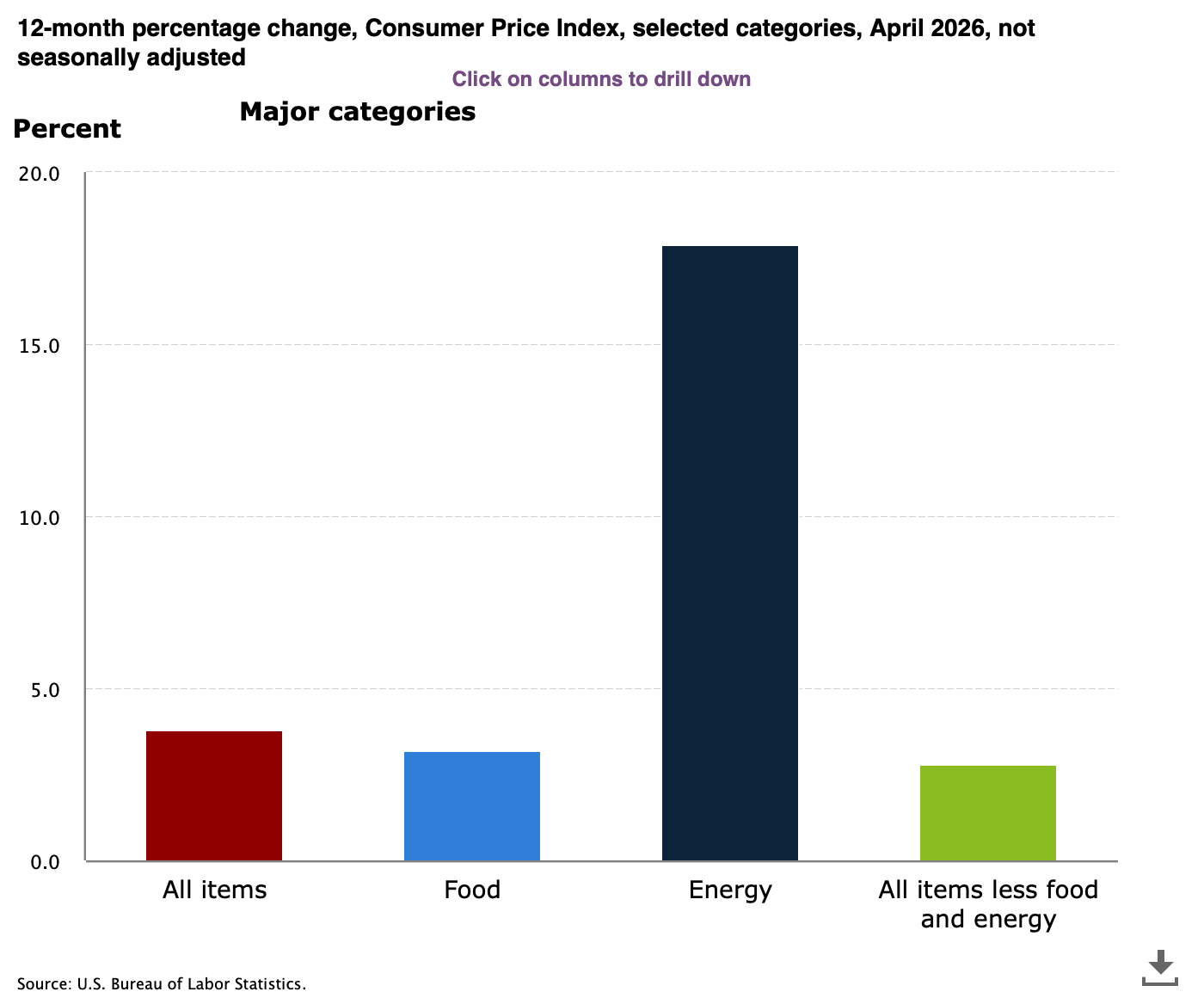
According to a New York Times article published just hours ago, the Consumer Price Index, a marker for inflation, soared in April to 3.8%, from 3.3% in March. Here’s a chart fresh from the Bureau of Labor Statistics (BLS) showing the increase in select categories of goods and services over the last 12 month period. Check out the BLS here for more charts, if you dare.
Inflation is painful for tens of millions of Americans, but for those living on a fixed income, mostly seniors and the disabled, it can mean choosing among rent, food or keeping the lights on at the end of each month. Here are the numbers according to the Social Security Administration‘s (SSA.gov) Monthly Statistical Snapshot for April, 2026.
— There are over 75 million social security recipients, including retirees, the disabled, their survivors and those receiving Supplemental Security Income (SSI), a means tested program for the poor. Here are a few of the most recent numbers:
— The average Social Security monthly payment among all categories of recipients is $1,932.80, and for retired workers the average monthly payment is $2,071;
— Social Security monthly amounts are adjusted annually according to the Cost of Living Adjustment (COLA) formula. Benefits increased by 2.8% for 2026, but the 10% increase in Medicare Part B premiums, which are automatically deducted from social security checks, nearly erases this year’s cost of living increase;
— Social Security is the only form of income for over 22 million senior citizens; and…
— In the context of poverty, approximately 36 million people in the United States live at or below the official government poverty line as of 2024, the most recent year statistics are available from the U.S. Census Bureau, and approximately 15% or 9.2 million are senior citizens.
Some 50-60 million Americans live on a retirement income set by Social Security benefit amounts and perhaps one or more other fixed revenue streams like a pension and/or annuities payments. But these sources of income are typically fixed, with only small “cost-of-living” raises that never come close to matching the increase in prices for basic needs like food, housing and utilities. The problem when fixed incomes meet inflation is that prices for most goods and services go up, but the ability to pay for them stays the same.
And speaking of retired folks, 2026 is a historic peak for seniors, with approximately “11,400 Americans turning 65 each day”.
Food prices, for example, have gone up 34.6% from 2019, and continue to rise—an enormous jump in just under seven years, A February 2026 article in Nerdwallet does a good job of explaining why food prices have skyrocketed, but the reasons matter little to those with fixed purchasing power. The reasons, including corporate profiteering, should matter to our elected officials, though, who are well aware that millions of their senior constituents are making tradeoffs everyday—cutting back on nutritious food, staying housebound to save transportation costs and forgoing medicine in order to pay the rent and utilities.
The enormous, recent spike in oil prices has propelled inflation to greater heights, thanks to the war with Iran, which has not only increased the cost of gas, it has increased the cost of everything that uses oil, like transportation, and everything that is made with oil, like plastics, for example. Meanwhile, soaring prices for necessities continue to penalize not only Americans living on fixed incomes, but lower and middle-income earners, too. A PBS article explains the how and why behind our rising overall prices and how it relates to the surging cost of oil.
Yes, consumers at the lower end of the income spectrum are hurting the most from the sudden rise in gas prices. See this NY Times article published about a week ago::
Surging gas prices are inflaming a longstanding economic divide in America, as households with lower incomes struggle to pay more at the pump at a moment when prices are already elevated.
And consumers are getting frustrated and angry. The most recent Consumer Sentiment Survey from the University of Michigan released earlier this month shows consumer sentiment about the economy at record lows, the lowest since 2017, in fact.
Sadly, retirees seem to be more worried about money than they are about dying. And many are re-entering the workforce if they can, to either make ends meet or save more for their eventual retirement.
According to a May 9 article from NBC, Palm Springs:
While some re-enter the workforce for a sense of purpose, the primary driver in 2026 is cold, hard cash. According to the latest EBRI Retirement Confidence Survey, 64% of Americans now worry more about running out of money than they do about dying. Data from the most recent Employee Benefit Research Institute (EBRI) Retirement Confidence Survey published March 2026.
How is inflation impacting your household? What actions do you think our government should take to bring down the rising costs of goods and services? Please share your thoughts with The Poverty Trap community in the Comment Section below—thanks!