
Welcome to The Poverty Trap, a Newsletter and Podcast About the Politics And Policy Choices That Create a Cycle of Economic, Racial and Environmental Inequality...and What We Can Do To Change It.
Thinking about subscribing? Here’s what one paid subscriber recently had to say about The Poverty Trap:
“You do great work, Joan. I don’t always get to read your newsletter, but when I do, I leave more informed and more compassionate…” Amy B.
I’m including the “trailer” for the 2021 PBS documentary, “Corporate Welfare, Where’s The Outrage” again, along with the direct link to the hour long, PBS documentary here: https://www.pbs.org/video/corporate-welfare-ptwdrw/, because it is essential viewing if you want to sort out the ‘double talk” leading up to the mid-term elections and make better choices as you go to the polls this November.
It’s even more important to understand why our system continues to favor subsidies to businesses (aka Corporate welfare) over help to individuals and communities, and how the numbers actually break-down, so you have a better idea of where your tax dollars are going and who benefits from this windfall.
I don’t believe it’s as simple as corporations benefit and individuals and communities suffer. Although this is true, it’s more complicated and maybe more insidious than that statement implies.
Take this data from a Good Jobs First article published a little over a month ago:
The [list below shows] September 2025 data from 11 states, [Government Accounting Office ] GAO identified 46 companies that ranked among the top 25 employers of Medicaid or SNAP recipients in at least two states. Seventeen were among the 50 largest Fortune 500 employers. The state data are not nationally representative, but the pattern is unmistakable: large, profitable corporations are among the leading employers of workers who need public assistance.
Good Jobs First’s Subsidy Tracker adds another dimension. Eight prominent companies appearing in GAO’s employer tables have received at least $16.5 billion in disclosed state and local subsidies. This data are from both the GAO1 and the Good Jobs First data research team. Here’s how it breaks down according to the Good Jobs First article:
Corporation Disclosed Subsidies: Examples From GAO Employer Lists:
Amazon $15.16 Billion—Major Employer Of Medicaid And SNAP Recipients In Multiple States
FedEx $660.5 Million—Among Tennessee’s Top Employers Of SNAP Recipients (The Company Has A Huge Hub In Memphis)
Walmart $287.2 Million—Top Employer Of Medicaid Recipients In Georgia And Oklahoma
Target $189.8 Million—Appears Among Large Employers Of Benefit Recipients
Kroger $87.4 Million—Appears Among Major Grocery-Sector Employers
Dollar General $59.7 Million—Among Tennessee’s Top Employers Of SNAP Recipients
Dollar Tree $55.8 Million—Appears In State Employer Rankings
McDonald’s $11.8 Million—Among Tennessee’s Top Employers Of SNAP Recipients
Total $16.51 Billion
Source: Good Jobs First Subsidy Tracker and GAO-26-108703. Subsidy totals are cumulative disclosed awards nationwide and exclude awards for which dollar values were not disclosed.
And here are recent numbers from the GAO (Updated and released on July 22, 2026) that shows more specifically how many American workers are employed (both part-time and full-time) and still qualify for Medicaid and/or SNAP:
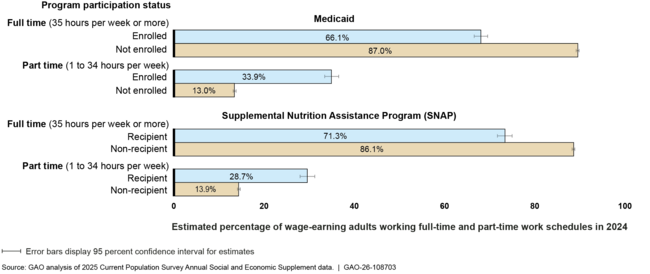
This is a taxpayer double whammy. We are paying corporations directly to continue to exist in our communities in the hope they will provide jobs. As I wrote in my previous post on corporate welfare, not only don’t the companies provide all the jobs promised, they many times abandon their factory and its community for cheaper locales, ripping away their meager paying jobs with little notice.
And here is the second insult, speaking of meager pay: The jobs pay so little that millions of workers who are employed by these companies across the country— even full-time workers— qualify for and receive Medicaid and SNAP food benefits. The taxpayers pay twice, while the corporations raking in billions of dollars in profits a year on the backs of low wage workers and inflated prices, get even more money…from you.
Although the United States has been using direct incentives, tax breaks and tariffs on imported goods to protect its businesses since the late 1700’s, this help usually resulted in investments for the general public and the public good, like railroads, sewage treatment and later, highways as good examples. Today, corporate subsidies benefit companies much more than the general public.
Fortunately, Robert Reich has written (and produced clever and informative videos) about this issue. The first video below was produced in 2019 during the first Trump Administration, but holds true today.
The second video explains how and why government subsidies and incentives to big business have changed over the years, and why a clear understanding of “corporate welfare” helps us cut through the double talk of politicians today.
You also should read this post from Substack’s own Judd Legum, author of Popular Information who published this post in July, discussing exactly how much taxpayers subsidize two of the biggest employers in the United States: Amazon and Walmart.: The amount of taxpayer money paying just for Medicaid alone annually is $2 billion!
————————————————
Thoughts on your money subsidizing big corporations…twice? Please share your ideas in the Comment Section, below. All are welcome!
The Government Accountability Office, the audit, evaluation, and investigative arm of Congress, exists to support Congress in meeting its constitutional responsibilities and to help improve the performance and accountability of the federal government for the American people. GAO examines the use of public funds; evaluates federal programs and policies; and provides analyses, recommendations, and other assistance to help Congress make informed oversight, policy, and funding decisions. (GAO)